

Feeder Cable
Feeder Cable for RF, Telecom & High-Frequency Signal Transmission
Feeder Cable is a critical transmission component used to carry RF signals between transmitters, antennas and other high-frequency communication equipment. For telecom, broadcasting, satellite communication and RF infrastructure projects, feeder cable performance directly affects signal loss, power handling and overall transmission reliability.

types of CNC machining
|
1/4" Feeder Cable |
Compact option for limited installation space. Suitable for equipment interconnection and RF transmission where routing flexibility is important. |
|
3/8" Feeder Cable |
Available in standard and super-flexible configurations for RF systems balancing transmission performance and installation flexibility. |
|
1/2" RF Feeder Cable |
Common size for communication infrastructure and RF systems. Construction options vary by attenuation, power, and installation requirements. |
|
7/8" Low Loss Feeder Cable |
Designed for lower attenuation and higher power handling. Suitable for demanding transmission routes where minimizing feeder loss is key. |
|
7/8" Superflex RF Coax Cable |
Provides greater flexibility for equipment connections, bends, and restricted routing spaces. |
|
1-1/4" Aluminum RF Feeder Cable |
Larger-diameter solution for high RF performance with lightweight aluminum construction. |
|
1-5/8" Aluminum RF Feeder Cable |
Large-size feeder for demanding transmission systems with higher performance and power-handling requirements. |
|
Super Flexible RF Feeder Cable |
Designed for sections where conventional rigid feeder cables are difficult to route. |
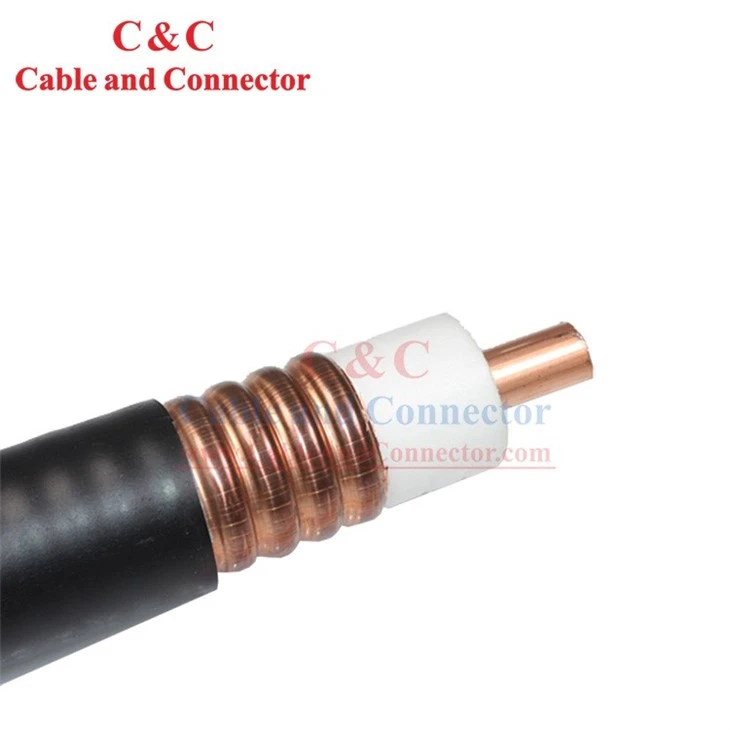
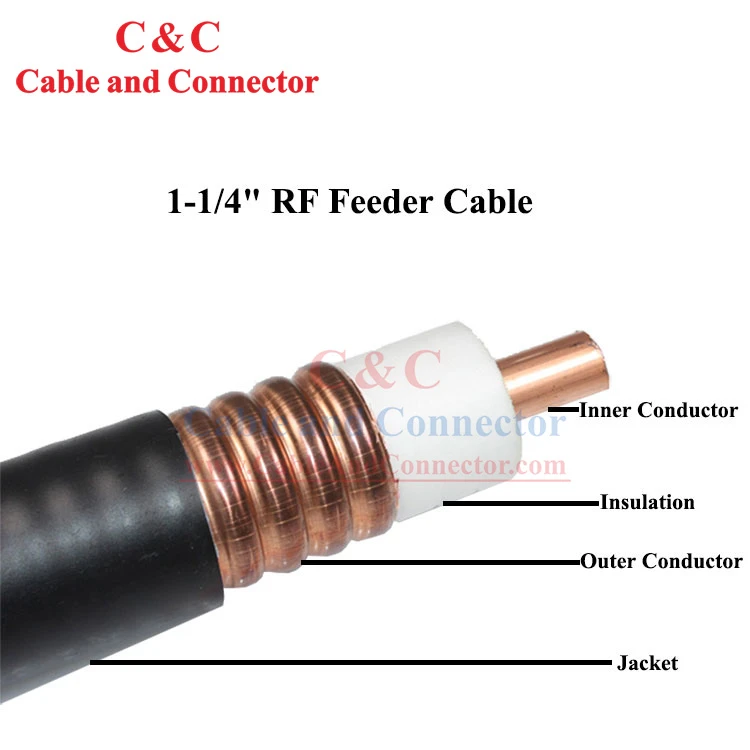
A reliable RF feeder cable depends on the coordinated performance of its internal and external construction.
Inner Conductor:Carries the RF signal. Material, diameter, and surface quality directly influence electrical resistance and transmission performance.
Dielectric:Maintains spacing between inner and outer conductors. Contributes to impedance and velocity of propagation.
Outer Conductor / Shield:Provides the RF signal return path and shields against external electromagnetic interference.
Outer Jacket:Protects the cable from mechanical damage and environmental exposure. For outdoor use, evaluate jacket material against UV, temperature, moisture, and installation conditions.
How to select the right feeder
|
Application |
Typical Band |
Suggested Diameter |
Why |
|
Indoor DAS / jumper |
0.7–3.5 GHz |
1/4" – 3/8" (superflex) |
Short runs, tight bends, low loss budget |
|
Small cell / RRU feed |
1.8–3.5 GHz |
1/2" (std or superflex) |
Balanced loss and handling |
|
Macro BTS, short tower |
0.7–2.6 GHz |
1/2" – 7/8" |
Medium runs up the mast |
|
Macro BTS, long feeder |
1.8–2.6 GHz |
7/8" – 1-1/4" |
Long runs where loss dominates |
|
High-power / long haul |
<2.6 GHz |
1-5/8" |
Lowest loss, highest power handling |
Temperature & Outdoor Deployment
Feeder cable may be exposed to substantial temperature variation during storage, installation, and operation.
Reference Temperature Ranges (model-specific)
- Storage: –70°C to +85°C
- Installation: –40°C to +60°C
- Operation: –55°C to +85°C
For outdoor projects, also consider
UV exposure, rain and moisture, temperature cycling, mechanical vibration, wind loading, installation altitude, and long-term environmental exposure.
Connector Compatibility Matters
A feeder cable is only as reliable as the complete cable assembly.
Important connector considerations include: Connector type, connector size, cable diameter, termination method, impedance, frequency range, power handling, and environmental protection.
For projects requiring complete assemblies, cable and connector specifications should be confirmed together rather than sourced independently.
Install It Right
Bend radius & support
Respect the minimum bend radius — kinking collapses the foam dielectric and wrecks return loss. Support the cable with clamps at spec spacing so it cannot whip in wind or creep at the connector.
Terminate with a matched connector
A feeder is only as good as its termination. Use 50 Ω interfaces (7/16, 4.3/10, N, or our F/58 family) matched to the cable diameter and PIM-class. Mismatched connectors add VSWR and intermod.
Weatherproof the joint
Outdoor connectors need sealing boots / self-amalgamating tape. Water ingress is the cause of creeping VSWR and PIM drift after commissioning.
Superflex only where needed
Run standard cable on the straight mast sections and switch to superflex at the bend to the RRU/antenna. This keeps loss low and cost sane.
Quality Control for Feeder Cable

For large RF infrastructure projects, consistency between production batches is critical because cable performance can directly affect system commissioning.Our quality-control approach focuses on both raw materials and finished cable performance.
Raw Material Inspection:The IPQC process checks incoming raw materials before they enter production.
Dimensional Control:Cable dimensions and construction are controlled according to the specified product design.
Electrical Performance Testing:Applicable electrical parameters can be checked according to the product specification, including impedance, resistance, insulation and other relevant RF characteristics.
Mechanical Testing:Mechanical characteristics such as tensile strength and bending performance can be evaluated according to the applicable specification.
Production Equipment: For large-scale project orders, the required inspection items and documents can be confirmed before production.
Regarding our company
ZheJiang Cable And Connector Optic Co., Ltd. is a high-tech enterprise based in Hangzhou, China, founded by a team of industry technicians and R&D engineers with over 20 years of experience. We are committed to "customer satisfaction" and providing full communication solutions. With a professional team, advanced production equipment, and certifications including ISO, RoHS, CE, and UL, our products are exported to Europe, North America, South America, and Asia, serving backbone, access networks, broadcasting, power grid, and railway industries.
Packaging & Delivery for Bulk Orders
Feeder cable is normally supplied in packaging suitable for protecting long cable lengths during storage and transportation.
Packaging can be arranged according to:
- Cable length per drum
- Drum dimensions
- Cable weight
- Export requirements
For international orders, shipping arrangements can be selected according to order volume and destination, including sea freight, air freight and other suitable transportation methods.
FAQ
As one of the most professional feeder cable manufacturers and suppliers in China, we have world-leading production equipment and strong manufacturing capabilities. Please rest assured to wholesale custom made feeder cable at competitive price from our factory.