

F Connector
F Connector for Reliable Coaxial Cable Termination
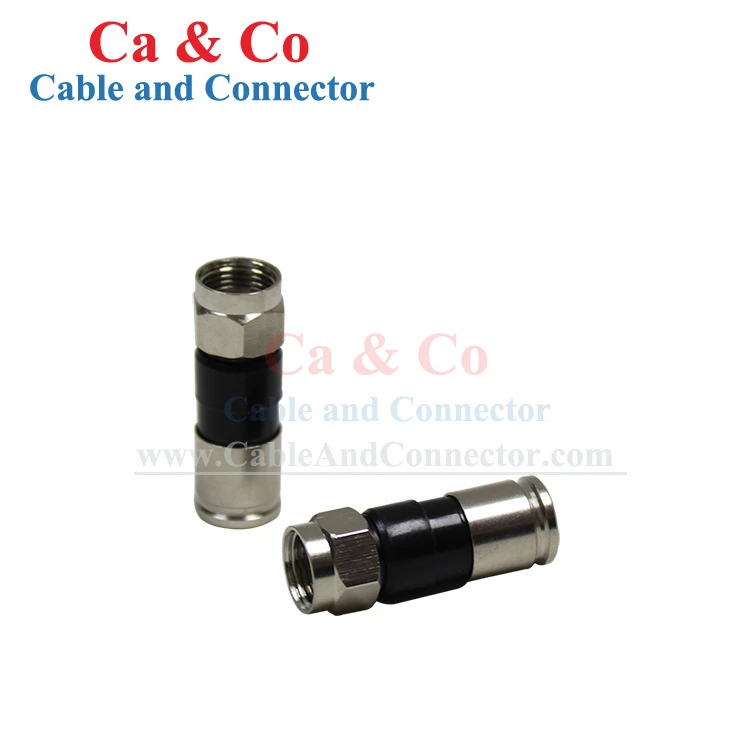
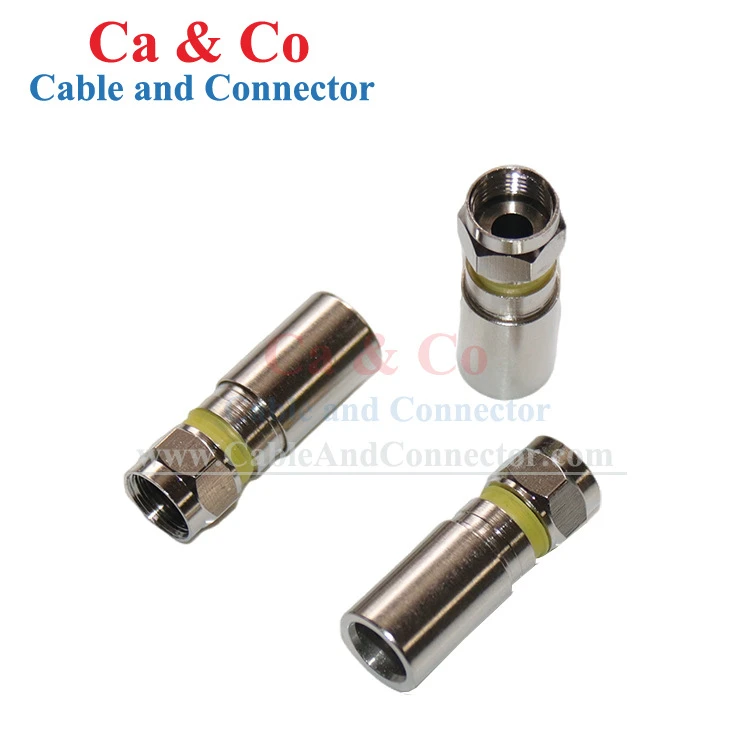
F Connector is a threaded coaxial connector widely used for terminating coaxial cables and connecting them to televisions, cable equipment, antennas, splitters, amplifiers, broadband equipment and other RF signal systems.


Technical Specifications
|
Parameter |
Details |
|
Impedance |
75 Ω |
|
Frequency range |
DC – 1 GHz (precision to 3 GHz) |
|
VSWR |
≤ 1.2:1 (typ. up to 1.5:1 max) |
|
Return loss |
≥ 20 dB @ 1 GHz; ≥ 18 dB across 5–3000 MHz (SCTE 04) |
|
Insertion loss |
≤ 0.3 dB @ 1 GHz |
|
Center contact resistance |
≤ 10 mΩ |
|
Outer contact resistance |
≤ 1 mΩ |
|
Insulation resistance |
≥ 5 GΩ |
|
Working voltage |
500 Vrms |
|
Mating cycles |
≥ 500 |
|
Coupling thread |
3/8-32 UNEF |
|
Recommended torque |
1.70 – 2.26 Nm |
|
Operating temperature |
−40 °C to +85 °C |
|
Cable compatibility |
RG6 (1.02 mm / 18 AWG), RG59 (0.64–0.81 mm), RG11 (1.63 mm / 14 AWG) |
|
Body / plating |
Brass, nickel plated; PTFE/Delrin insulator; optional O-ring |
How an F Connector Works
Center conductor must be solid, not stranded
F connectors are sized for a solid 18 AWG (RG6) / 14 AWG (RG11) pin. Stranded-center cable cannot form a reliable contact and should not be used with standard F terminations.
Impedance is set by the cable + termination together
A 75 Ω system needs 75 Ω cable and a connector that preserves that impedance through the mating interface. Any discontinuity (over-stripped braid, bent pin, cross-threaded nut) creates a reflection.
Shield type changes the body
Tri-shield and quad-shield RG6 have a larger effective diameter; the connector ferrule/compression ring must seat against that shield, or the seal and retention both fail.

Key Points for Purchasing F Connectors
Cable Fit:A correct fit between connector and cable is fundamental. The connector should properly accommodate outer jacket diameter, shielding layer, dielectric, center conductor, and cable geometry. An incorrectly matched connector may be difficult to install or may not provide sufficient mechanical retention.
Electrical Performance:For RF and CATV applications, check frequency range, characteristic impedance, contact resistance, insulation resistance, working voltage, withstand voltage, and return loss/VSWR where applicable.
Indoor vs. Outdoor F Connector Selection
Indoor Applications
For TV, CATV, broadband, and equipment connections, priorities focus on cable compatibility, installation speed, electrical performance, cost per connection, and connector availability.
Outdoor Applications
Additional attention to environmental exposure is required. Evaluate moisture resistance, water ingress protection, corrosion resistance, UV exposure, temperature range, cable jacket compatibility, and additional waterproofing requirements.
Choose the Right F Connector by Application & Environment
|
Use Case |
Typical Requirement |
Recommended Option |
Caveat |
|
Outdoor CATV / broadband drop, rooftop or aerial |
Weatherproof seal, high retention |
Compression F connector, RG6 tri/quad-shield, dual O-ring |
Crimp & twist-on are not sealed — reject for exposed runs |
|
Satellite dish to receiver (outdoor) |
Low leakage, corrosion resistance |
Nickel-plated brass compression connector |
Verify salt-spray rating for coastal sites *[verify] |
|
Indoor wall plate / patch / MDU closet |
Speed, cost, low volume of exposed joints |
Crimp or compression, RG6 |
Match die to connector series |
|
Emergency / temporary / field repair |
No tooling, reusable |
Twist-on F connector |
Replace with compression at first maintenance window |
|
Long trunk / low-loss run |
Larger center conductor |
RG11 compression connector (14 AWG) |
Do not use an RG6 body on RG11 cable |
|
High-EMI / broadcast-adjacent plant |
Maximum shielding |
Quad-shield compression connector |
Confirm body seats on quad shield OD |
Our quality-control approach focuses on:
Incoming Material Inspection:The IPQC process checks purchased raw materials before they enter production.
Dimensional Control:Connector dimensions and cable-fitting areas should remain within the specified tolerances to ensure consistent assembly.
Contact Performance:Applicable contact and electrical characteristics can be checked according to the product specification.
Assembly Verification:The connector should be evaluated together with the intended coaxial cable to confirm proper termination and mechanical retention.
Why Buyers Work With Us
ZheJiang Cable And Connector Optic Co., Ltd. is a high-tech enterprise based in Hangzhou, China, founded by a team of industry technicians and R&D engineers with over 20 years of experience. We are committed to "customer satisfaction" and providing full communication solutions. With a professional team, advanced production equipment, and certifications including ISO, RoHS, CE, and UL, our products are exported to Europe, North America, South America, and Asia, serving backbone, access networks, broadcasting, power grid, and railway industries.
Packaging & Shipping
Packaging
- Individual PE bags or protective packaging
- Inner boxes for SKU separation
- Export-standard cartons
- Palletized cartons for bulk orders
- Customized labels, quantities and private-label packaging
Shipping
- Sea Freight: Cost-effective for bulk and project orders
- Air Freight: Suitable for samples and urgent orders
- Rail Freight: Available for selected international routes
- Road Freight: Suitable for domestic and regional delivery
Certificates
Available qualifications and supporting documents include:
ISO 9001
1
>>
UL
2
>>
CSA
3
>>
CCC
4
>>
RoHS
5
>>
REACH
6
FAQ
As one of the most professional f connector manufacturers and suppliers in China, we have world-leading production equipment and strong manufacturing capabilities. Please rest assured to wholesale custom made f connector at competitive price from our factory.