

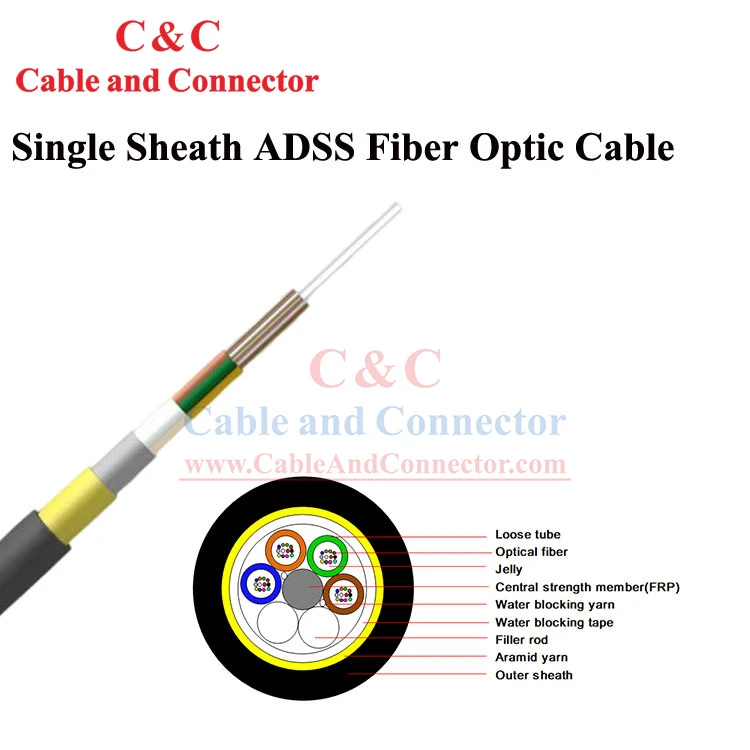


The ADSS Aerial Fiber Optic Cable is an all-dielectric, self-supporting cable for overhead fiber communication networks. Fiber counts from 4F to 144F and span configurations from 50 m to 600 m or longer are available according to project requirements.
Technical Specifications
|
Item |
Specification |
|
Cable Type |
ADSS Aerial Fiber Optic Cable |
|
Fiber Count |
4 / 6 / 8 / 12 / 24 / 36 / 48 / 60 / 72 / 96 / 144F |
|
Reference Fiber Count |
48F |
|
Fibers per Tube |
12 |
|
Number of Elements |
6 |
|
Outer Sheath Thickness |
1.8 mm |
|
Cable Diameter |
12.9 mm ±5% |
|
Cable Weight |
120 kg/km ±10% |
|
Maximum Allowable Tension |
3,000 N |
|
Short-Term Crush |
1,000 N/100 mm |
|
Reference Span |
60 m |
|
Fiber Type |
G.652D |
|
Static Bend Radius |
10 × Cable Diameter |
|
Dynamic Bend Radius |
20 × Cable Diameter |
|
Operating Temperature |
-40°C to +60°C |
|
Installation Temperature |
-10°C to +60°C |
|
Storage/Transportation Temperature |
-40°C to +60°C |
Mechanical dimensions and values shown above are nominal reference data for the 48F / 60 m configuration.
ADSS Cable Construction
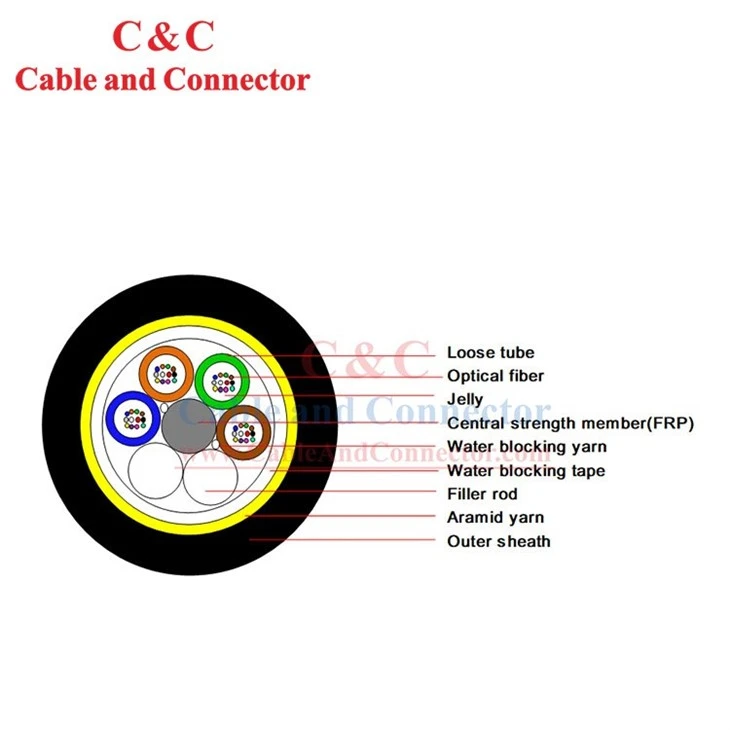
All-Dielectric Structure: The cable uses non-metallic components throughout its construction, eliminating the need for a metallic messenger in self-supporting aerial installation.
Fiber Tube Arrangement: The reference 48F configuration contains six cable elements with 12 fibers arranged in each tube.
Water Protection: The cable construction incorporates moisture protection around the optical fiber units for outdoor cable deployment.
Outer Sheath: The reference configuration uses a 1.8 mm nominal outer sheath, with a finished cable diameter of approximately 12.9 mm.

Optical & Environmental Performance
Low Attenuation: ≤0.36 dB/km at 1310 nm and ≤0.22 dB/km at 1550 nm, helping reduce signal loss and preserve transmission margin over longer cable runs.
Defined Mode Field Diameter: 9.2 ±0.4 μm at 1310 nm and 10.4 ±0.8 μm at 1550 nm, supporting consistent single-mode transmission and fiber connection compatibility.
Controlled Chromatic Dispersion: ≤3.5 ps/(nm·km) from 1288–1339 nm and ≤18 ps/(nm·km) at 1550 nm, helping limit pulse spreading on longer transmission links.
Low Bending Loss: ≤0.05 dB after 100 turns at a 30 mm radius, helping minimize additional optical loss during cable routing and installation.
Standards & Testing
Fiber Specification: The reference configuration uses G.652D fiber with defined attenuation, mode field diameter, dispersion and bending-loss requirements.
Mechanical Verification: The stated cable data includes maximum allowable tension, short-term crush resistance and minimum bend-radius requirements for mechanical evaluation.
Project Compliance: Applicable cable specifications and testing requirements can be confirmed against the purchaser's technical specification before production.


FAQ
Q: How do I choose the right ADSS cable span?
A: Select the span according to pole spacing and installation conditions. Options range from 50 m to 600 m.
Q: What information is needed for a quotation?
A: Provide fiber count, required span, cable length, quantity and installation requirements.
Q: What fiber counts are available?
A: Options range from 4F to 144F, including 4F, 6F, 8F, 12F, 24F, 36F, 48F, 60F, 72F, 96F and 144F.
Q: Can the cable be configured for a specific project?
A: Yes. Fiber count, span and mechanical requirements can be specified according to the project.
Q: Can the cable length per reel be specified?
A: Yes. Reel length can be arranged according to order and transportation requirements.
Q: Can customer-specific marking and packaging be provided?
A: Yes. Cable identification and packaging requirements can be specified for the order.
Q: What technical information is available before ordering?
A: Technical data covering cable construction, mechanical performance, fiber specifications and operating conditions is available for buyer review.
Hot Tags: adss aerial fiber optic cable, China adss aerial fiber optic cable manufacturers, suppliers, factory
